
Floating
Treads anchored to a concealed wall-mounted steel spine/stringer, giving the appearance of cantilevered floating steps with engineered rigidity under load.
- Hidden steel stringer
- Single / double landings
- Multi-floor configurations
Architectural staircases engineered to stand out, combining structural precision with bespoke steel craftsmanship.
Configurations
Each staircase is engineered around a steel stringer system and fabricated in house, with coordination carried out alongside joinery, glazing, and finishing contractors to ensure smooth installation and design integration.
Treads anchored to a concealed wall-mounted steel spine/stringer, giving the appearance of cantilevered floating steps with engineered rigidity under load.
Compact circular staircase built around a central steel column, with treads winding continuously around the pole for efficient vertical circulation in tight spaces.
Two-flight staircase connected by an intermediate landing where the flights turn 180°, built with single or twin steel stringers for structural stability and efficient circulation.
Linear single-flight staircase fabricated with single or twin steel stringers for clean geometry and efficient structural support in residential and commercial spaces.
Minimal staircase design using a central steel stringer running beneath the treads to support both sides, creating an open architectural appearance.
Curved architectural staircase fabricated with rolled steel stringers winding around an open well to create continuous flowing geometry between floors.
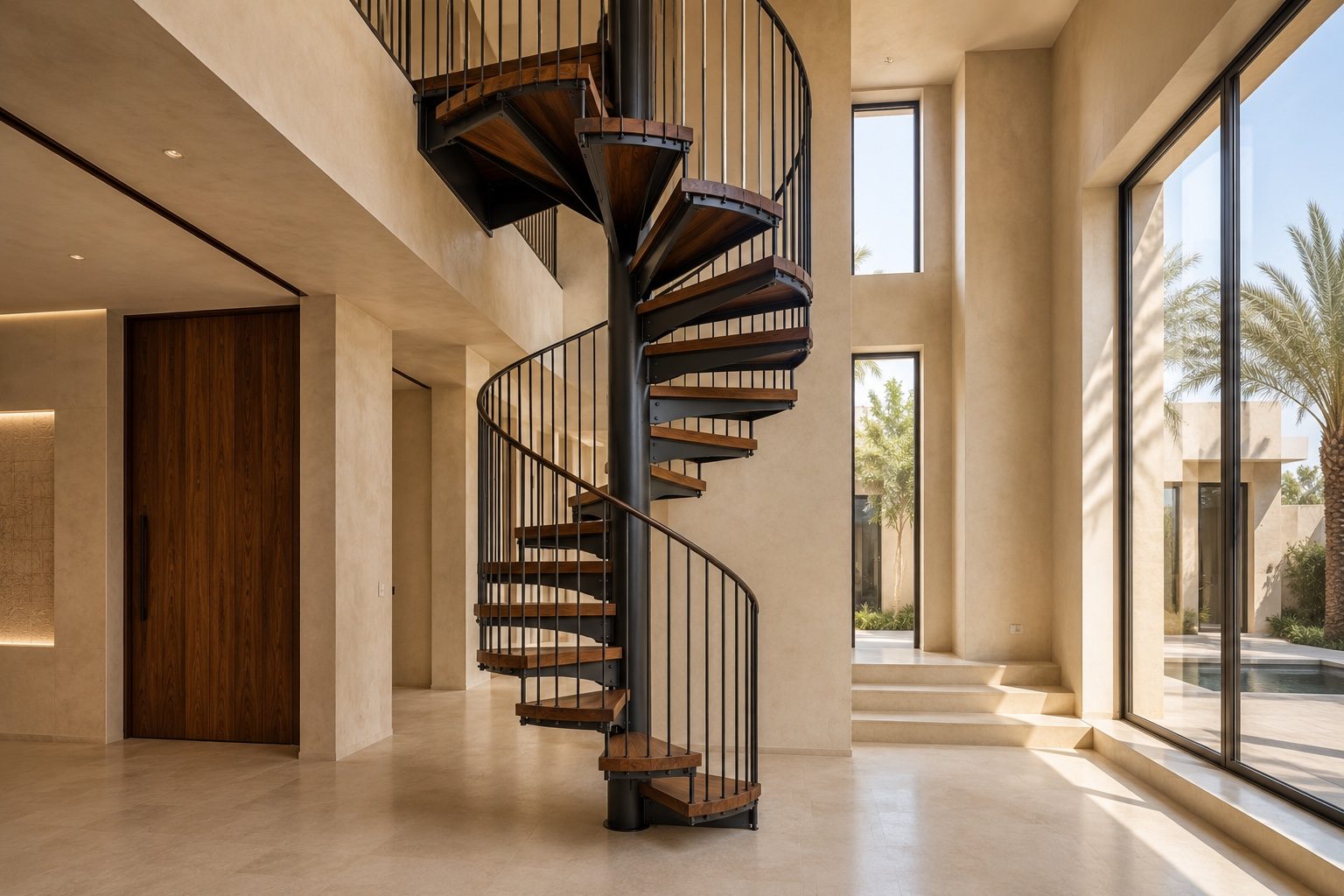
C.01 Detail
Most staircase problems start at the structural level, tread movement, unstable handrails, weak connections, or poor fabrication tolerances. That's why we focus first on structural engineering, accurate steel fabrication, and coordinated detailing before the finishing stage begins.
Our staircases are engineered for strength, stability, and long-term performance, with every project supported by shop drawings, structural load calculations, finish specifications, and documented quality procedures aligned with project and authority requirements.
C.02 Recent


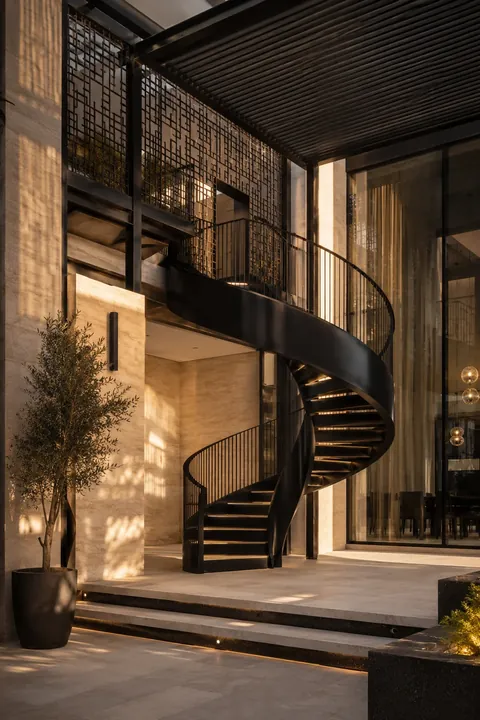


Finesse designs and fabricates structural and decorative steel staircases for villas, commercial buildings, warehouses, and industrial sites. From code-compliant escape stairs to high-end architectural feature staircases, every project is designed to the Dubai Building Code 2021 and the UAE Fire and Life Safety Code, fabricated by our qualified welders, and inspected under our ISO 9001 system.
Yes, in almost all cases. A new staircase, a replacement staircase with a different layout, or a staircase added during a renovation forms part of the building's means of escape, so it falls under the Dubai Municipality building permit. For staircases inside commercial, industrial, and multi-occupancy buildings, Civil Defence approval is also required because the staircase is part of the fire evacuation strategy.
Internal decorative staircases inside a private villa, where the layout does not change, may not need a separate permit if the work is part of an approved renovation package.
Staircases in Dubai are designed under:
Reference: Dubai Municipality, Dubai Building Code
For residential stairs, Dubai Building Code 2021 (Part B) sets the baseline geometry:
Industrial access stairs to BS 5395 use a steeper geometry (typical 230 mm tread / 220 mm riser) with reduced headroom permitted on access-only stairs. Means-of-escape stairs in commercial and assembly occupancies pick up wider minimums under the UAE FLSC. Every stair is designed to the actual use category, not a single template.
References: Dubai Building Code 2021; BS 5395 (BSI)
Handrails and balustrades must resist a defined horizontal load applied at the top of the rail, plus a defined uniformly distributed load. Under BS 6180, typical design loads are:
Finesse fabricates the steel structure (stringers, mounting plates, and the steel or stainless balustrade frame) to the same loads. Every balustrade is designed for its actual occupancy category, not a generic default. Infill panels, where specified by the architect, are supplied and installed by a separate specialist contractor against our shop drawings.
More questions
We fabricate the complete steel staircase structure, including steel handrails and support systems. Where timber treads or other architectural finishes are specified, we coordinate closely with joinery and finishing contractors for smooth integration on site.
Yes. Custom architectural staircases are a regular part of our work. We accept your architect's design, develop the structural shop drawings, run the load checks through a licensed consultant, and coordinate finishes and lighting with the rest of the interior package. Joinery, glazing, and finishing elements supplied by separate contractors are coordinated and fitted onto our steel frame on site. For complex floating or helical stairs, we provide a 3D model for client and architect approval before fabrication starts.
Structural welds on stringers, landings, and connections follow the AWS D1.1/D1.1M Structural Welding Code for Steel. Every weld is visually inspected by our experienced QC team. For permanent staircases in commercial or industrial buildings, or those carrying heavy occupancy loads, we engage accredited third-party testing laboratories for Magnetic Particle Inspection on critical welds, torque tests on bolted connections, and pull-out tests on anchor bolts.
For temporary staircases, light-duty access stairs, or simple low-occupancy residential stairs, this level of third-party NDT is not normally required. We adjust the inspection regime to match the application.